Selecting the right professional to document your company’s milestones is a high-stakes decision. Whether you are planning a massive multi-day summit in Las Vegas, a high-stakes executive roundtable in New York City, or a vibrant product launch in Los Angeles, the quality of your visual assets will dictate your brand’s narrative for years to come. Corporate event photography is more than just "taking pictures"; it is a strategic exercise in brand building, marketing, and historical archiving.
To secure the best results, you must look beyond the surface level of a portfolio and dive into the technical capabilities, logistical expertise, and professional reliability of your chosen event photographer.
Define Your Visual Objectives Early
Before searching for corporate photography services, pinpoint the exact purpose of the imagery. Different events require different skill sets. A conference photographer must be adept at capturing candid interactions in low-light environments, while a photographer for a gala needs to master formal portraits and high-speed action on a stage.
Start by identifying the primary use cases for the files:
- Marketing and PR: High-resolution images for press releases and future promotional materials.
- Social Media: Rapid-turnaround "sneak peeks" for real-time engagement on LinkedIn or Instagram.
- Internal Culture: Capturing team-building moments to foster employee morale and recruitment.
- Sponsorship Fulfillment: Documenting brand activations and sponsor booths to prove ROI to stakeholders.
If your event includes dynamic speakers or workshops, you should also consider event videography services. Integrating event video production ensures you have a comprehensive library of content, ranging from 60-second sizzle reels to full-length keynote recordings. For deeper insights into specific event types, explore our guide on mastering corporate event photography.
Evaluate Portfolios for Corporate Relevance
A common mistake is hiring a talented wedding or portrait photographer for a business setting. The requirements for business event photography are vastly different. When reviewing portfolios, look for consistency in color, lighting, and composition across various venues.
Consistency in Lighting
Corporate venues: ranging from the glass-walled skyscrapers of Chicago to the cavernous convention centers of Orlando: present nightmare lighting scenarios. A top-tier corporate event photographer knows how to balance ambient light with professional flash without creating harsh shadows or "washing out" the subjects.
The Ability to Capture Emotion
Professionalism does not mean sterility. Look for images that show engagement: a laughing executive during a break, an intense discussion during a corporate panel discussion, or the focused energy of a corporate workshop.

Alt Text: A professional conference photographer capturing a keynote speaker on a brightly lit stage in a large convention center, focusing on the speaker's engagement with the audience.
Technical Proficiency and Equipment Standards
The gear a photographer carries is a direct reflection of their commitment to the craft. While the "eye" of the artist matters, the limitations of entry-level equipment can ruin a shoot in challenging environments.
Ask prospective photographers about their "kit" for conference photography:
- Dual Camera Bodies: A professional always shoots with two cameras to avoid missing a moment due to a technical failure.
- Fast Lenses: F/2.8 or faster lenses are essential for capturing sharp images in dimly lit ballrooms without excessive grain.
- Silent Shutter Capability: High-profile meetings, such as an executive roundtable, require a photographer who can work silently without the distracting "click" of a traditional shutter.
If you are also booking event videography services, ensure the team utilizes 4K resolution cameras and professional audio recording equipment. Lapel mics or direct board feeds are non-negotiable for high-quality conference videography.
Navigating Logistics in Major US Hubs
Finding a local event photographer in a major city requires an understanding of that city's unique logistical challenges. At Corporate Pixels, we specialize in navigating these complexities across the United States. You can also find vetted professionals through networks like www.proshoot.io, which simplifies the search for high-end creators.
New York City
Logistics in NYC are defined by tight schedules and even tighter spaces. Whether you are hosting at the Javits Center or a boutique hotel in Soho, your photographer must be mobile. Look for a team that understands NYC parking, security protocols in high-rise buildings, and the need for quick movement between breakout rooms.
Las Vegas and Orlando
These are the kings of the "mega-conference." A conference photographer in these cities must have the stamina to cover miles of trade show floor. Experience with trade show photography is vital here, as capturing the scale of these events requires wide-angle lenses and strategic positioning.
San Francisco and Austin
Tech-centric cities often lean toward a more "lifestyle" approach to corporate event photography. The aesthetic is often brighter, more candid, and focused on innovation. If you are planning a product launch, ensure your photographer understands how to highlight the sleekness of your tech and the energy of the crowd.
The Importance of Event Video Production
In 2026, static images are only half the story. High-impact event video production is now a standard requirement for major corporate gatherings. A corporate event videographer works alongside the photography team to capture the "vibe" of the event in motion.
Key deliverables to request from your videography team:
- The Sizzle Reel: A 1-2 minute high-energy video set to music, perfect for social media and recap emails.
- Interviews and Testimonials: Catching attendees and stakeholders in the moment to provide social proof for your brand.
- Full Session Capture: Essential for archival purposes and for those who couldn't attend in person.
By hiring a unified team for both photography and videography, you ensure a cohesive visual style and better on-site coordination. For more on video strategy, see our section on mastering business conference photography which covers the integration of multimedia.

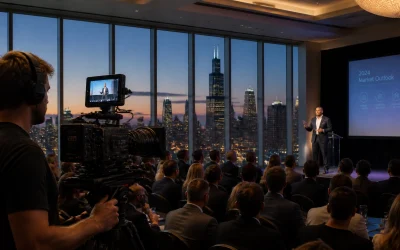
Alt Text: An event video production crew setting up a multi-camera shoot for a corporate gala, including a stabilizer rig and professional audio monitoring equipment.
Vet for Professionalism and Brand Alignment
The event photographer you hire becomes an extension of your staff for the duration of the event. They will interact with your CEOs, your VIP clients, and your newest hires.
Attire and Demeanor
Confirm that the photographer understands the dress code. For a company gala, they should be in formal attire or "event blacks" to blend in. For a team-building event in a casual setting, they should dress appropriately while still appearing professional.
Proactive Problem Solving
The best photographers don't wait for instructions once the event begins. They have reviewed the schedule, pinpointed the key stakeholders, and identified the best angles for the "hero shots" well in advance. They should be able to navigate a crowded business luncheon without disrupting the meal or the speakers.
Pricing and Contracts: Understanding the Value
When evaluating quotes for corporate photography services, look for transparency. Cheap is often expensive in the long run if the images are unusable or the photographer fails to show up.
A standard professional contract should include:
- Usage Rights: For corporate work, you typically want full commercial usage rights so you can use the images in any marketing capacity.
- Delivery Timeline: Standard delivery is often 1-2 weeks, but many photographers offer "next-day" highlights for an additional fee.
- Insurance: Any professional working in a major US venue must carry General Liability Insurance. Most hotels and convention centers will not allow them on-site without it.
- Backup Plan: What happens if the lead photographer is incapacitated? A reputable agency like Corporate Pixels always has a contingency plan.
For specialized events like awards ceremonies, ensure the contract specifies the delivery of "handshake shots" or "staged trophy shots," which are critical for PR.
Post-Event Workflow and Asset Management
The job isn't over when the lights go down. The post-production phase is where the "raw" data is transformed into a professional asset.
Culling and Editing
A professional event photographer will sort through thousands of images to select the best 5-10% that tell the story of your day. These images should be edited for color balance, exposure, and cropping to ensure they meet your brand standards.
Digital Delivery
Look for photographers who use modern gallery platforms. These allow you to easily share folders with different departments: PR gets the high-res files, while the social media team gets the web-optimized versions.
If you are managing a large-scale project across multiple cities, using a centralized platform like www.proshoot.io can help you maintain a consistent quality standard regardless of the location.

Alt Text: A high-end digital gallery interface showing a curated collection of corporate event photos, including keynote speakers, networking sessions, and architectural shots of the venue.
Long-Term Partnerships vs. One-Off Gigs
If your company hosts multiple events per year: such as an annual meeting, a holiday party, and several seminars: there is immense value in building a relationship with a single photography partner.
A recurring event photographer learns your brand's "look." They know which executives prefer to be photographed from which side, which sponsors need the most visibility, and what the internal tone of the company is. This institutional knowledge reduces the "ramp-up" time for every event and ensures a seamless visual identity across your entire corporate history.
Whether it's a charity event or a company anniversary, the consistency of a dedicated partner like Corporate Pixels allows you to focus on the event itself, knowing the visual legacy is in expert hands.
Final Checklist for Hiring
- Portfolio Review: Does their work match your event's specific style?
- Experience: Have they worked in this specific city or venue before?
- Video Capabilities: Do they offer event videography services to complement the stills?
- Professionalism: Do they have a clear contract, insurance, and a professional demeanor?
- Technical Specs: Are they using pro-grade gear and providing high-res, edited files?
- References: Can they provide testimonials from other corporate clients?
By following these guidelines, you can confidently secure a corporate event photographer who will not only document your event but elevate your brand’s presence in the marketplace. For those looking for the gold standard in the industry, visit Corporate Pixels to see how we handle events in every major US city.