Las Vegas stands as the global epicentre for large-scale industry gatherings, hosting thousands of conventions annually at venues like the Las Vegas Convention Center, Mandalay Bay, and Caesars Forum. For a conference photographer, the sheer scale of these environments presents unique challenges and opportunities. Success in this high-stakes environment requires more than just a camera; it demands a strategic fusion of technical mastery, logistical planning, and an understanding of corporate branding.
Mastering the Las Vegas Venue Landscape
Visualise the environment before you step onto the floor. Las Vegas convention spaces are notorious for their massive footprints and unpredictable lighting. Corporate event photography in these spaces often involves navigating vast exhibit halls with high ceilings and fluorescent overheads, followed immediately by dim, moody ballrooms for keynote presentations.
Pinpoint the specific layout of your venue during the pre-event phase. Each major hotel and convention center has its own architectural quirks. For example, the natural light available in the glass-heavy corridors of the Wynn is a world away from the windowless, cavernous halls of the Venetian Expo. Scout these locations 24 hours in advance to identify "power spots": angles where the branding is prominent and the background is clean. This preparation ensures that when the CEO takes the stage, you aren't hunting for a vantage point; you are already positioned for the hero shot.

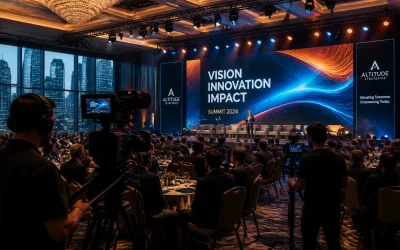
Alt text: A professional event photographer capturing a high-energy keynote speech at a major Las Vegas convention center with professional lighting.
Essential Gear for the High-Stakes Conference Photographer
Equip yourself with a kit that prioritizes versatility and reliability. In the world of corporate photography services, equipment failure is not an option. A dual-slot mirrorless camera body is the industry standard, providing real-time backups of every frame captured.
- Lenses: Carry a "holy trinity" of zooms: a 16-35mm f/2.8 for wide architectural and crowd shots, a 24-70mm f/2.8 for general coverage, and a 70-200mm f/2.8 for capturing speakers from the back of the room without being intrusive.
- Lighting: Utilize an external flash with TTL capabilities, but use it sparingly. In many high-end business event photography settings, ambient light is preferred to maintain the atmosphere created by the production team. Carry a MagMod or similar diffuser to soften shadows when flash is unavoidable.
- Stability: Pack a lightweight monopod. While a tripod is essential for event videography services, a monopod offers the mobility needed to move through dense crowds while providing enough stability for lower shutter speeds in dim breakout rooms.
Technical Settings: The Exposure Triangle in Action
Balance your ISO, aperture, and shutter speed to handle the rapid transitions of a live event. For fast-paced stage action, prioritize a high shutter speed: at least 1/500th of a second: to freeze hand gestures and walking movements.
Employ continuous autofocus (AF-C) with face and eye detection. Modern mirrorless systems allow a corporate event videographer or photographer to lock onto a subject and maintain tack-sharp focus even as they pace the stage. When shooting in the dark corridors of a Las Vegas resort, do not fear high ISO settings. Noise-reduction software in post-production is powerful, but a blurry image caused by a slow shutter speed is unsalvageable. Keep your aperture wide (f/2.8) to separate the speaker from the busy background, creating a professional bokeh effect that highlights the subject's authority.
Coordination Between Photography and Event Video Production
Align your efforts with the event video production team to ensure a seamless workflow. In Las Vegas, many large-scale conferences employ a full media crew. Communication is the bridge between a chaotic shoot and a successful one.
Before the keynote begins, coordinate with the lead conference videography specialist to establish "no-go" zones. You do not want to walk into their primary wide shot, and they do not want to block your line of sight to the podium. If the client requires both stills and video, consider how the two mediums complement each other. While the video captures the flow of the speech, your photography should capture the decisive moments: the handshake, the standing ovation, and the intense focus of the audience. For examples of how these elements come together in a professional setting, view our work on Project Name 2.

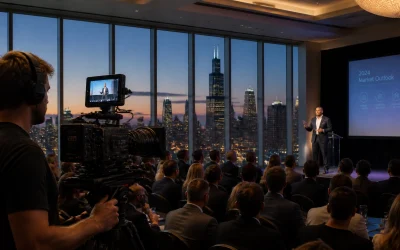
Alt text: Behind-the-scenes view of an event video production team and a conference photographer coordinating their positions during a live corporate presentation.
Capturing the "Fly on the Wall" Candid Moments
Authenticity is the currency of modern corporate photography services. While posed "grip and grin" shots have their place, marketing departments crave candid interactions that show genuine engagement.
Adopt a "fly on the wall" perspective. Observe the room for laughter, intense networking, and "lightbulb moments" during workshops. Use a telephoto lens to capture these interactions from a distance, allowing attendees to remain relaxed and unselfconscious. These images are invaluable for future promotional materials, as they depict the "human" side of a corporate brand. If you need inspiration for layout and composition in a multi-day event, explore our Single Grid Project.
Managing VIPs and Keynote Speakers
Label your priority subjects. Before the event, request a "hit list" of VIPs, executives, and guest speakers from the organizers. In Las Vegas, high-profile speakers often have limited time and may be surrounded by security.
Establish a rapport with the stage manager. They can provide you with the "run of show," detailing exactly when the speaker will enter and exit the stage. Position yourself at the "X" on the floor where the speaker is coached to stand for the best lighting. Capture the speaker from a low angle to convey power and leadership, ensuring the microphone or teleprompter does not obstruct their face. For high-end cosmetic or branding events, precision is even more critical; see our work with MAC Cosmetics for a look at detailed event coverage.
Strategic Positioning in Major Las Vegas Venues
Map out your movement patterns. At a venue like the Mandalay Bay Convention Center, the distance between the main stage and the breakout rooms can be half a mile.
- General Sessions: Arrive 30 minutes early to capture the empty room with the branding on the screens. As the room fills, move to the back to get the scale of the crowd.
- Breakout Rooms: These are often smaller and more intimate. Use a wide-angle lens to make the room feel full, even if attendance is light.
- Trade Show Floor: Focus on the interactions between exhibitors and attendees. Use the colorful booth displays as backdrops to create vibrant, energetic images that highlight the "hustle" of the event.
For more specialized layouts like masonry galleries that showcase the variety of a large event, check out our Full Masonry Gallery.
Post-Production and Rapid Delivery
Deliver results with speed. In the fast-paced world of social media, a photo delivered three days after the event is old news. Most Las Vegas clients expect a "teaser" gallery within hours of the keynote.
Implement a streamlined workflow. Use software like Adobe Lightroom to apply batch edits for color correction and exposure. Maintain a consistent look across the entire gallery: this is a hallmark of professional corporate event photography. Ensure all images are tagged with relevant metadata to assist the client’s SEO efforts. If you are looking for top-tier professionals to handle this workflow for your next event, visit Proshoot.io for specialized event coverage.

Alt text: A professional editor's workstation showing high-end photo editing software with a gallery of corporate conference images being processed.
Integrating Conference Videography
Expand your service offering by integrating conference videography. A corporate event videographer can capture testimonials, highlight reels, and full-session recordings that provide a massive ROI for the client.
When filming, stability is paramount. Use a gimbal or a heavy-duty tripod to ensure smooth movements. Capture "B-roll" of the Vegas skyline, the venue exterior, and the registration desk to provide context for the final video. This multi-angled approach ensures the client has a comprehensive digital asset library. You can see how we display these visual stories in our Video Gallery.
Why Las Vegas Requires a Local Expert
Partner with an event photographer who understands the local landscape. Las Vegas is a city of logistics. Knowing which elevators lead to the loading docks and which security guards control access to the VIP lounges can save hours of time.
A local conference photographer is also familiar with the specific lighting temperatures of different hotel ballrooms. For instance, the gold-tinted lighting in many legacy Vegas resorts requires a specific white balance adjustment to ensure skin tones look natural rather than jaundiced. By hiring a professional who specializes in this market, you ensure that the vibrancy of the city is captured without compromising the professional tone of your brand. Explore our Reports Category to see how we document these complex logistical events.
Conclusion: Elevating the Corporate Brand
Executing successful photography in the convention capital of the world requires a blend of technical skill and tactical intuition. By focusing on gear reliability, strategic venue scouting, and the seamless integration of event videography services, you provide the client with more than just images: you provide a legacy of their event's success.
Whether you are capturing a 50-person executive retreat or a 50,000-person tech summit, the principles remains the same: visualize the shot, pinpoint the moment, and deliver with precision. For more insights into professional event coverage across major USA cities, stay tuned to the Corporate Pixels Blog.