Las Vegas is the undisputed heavyweight champion of the world when it comes to hosting massive corporate gatherings. From the sprawling floors of the Las Vegas Convention Center to the high-tech ballrooms at ARIA or the Venetian, the scale is unlike anywhere else. But with that scale comes a unique set of challenges. If you’re tasked with documenting a three-day summit with 5,000 attendees, you can’t just "wing it" with a basic camera and a kit lens. Success in this environment requires a tactical approach, high-end technical knowledge, and a deep understanding of how to tell a brand’s story through a lens.
Whether you are a marketing manager hiring a conference photographer or a professional looking to sharpen your skills in the "Neon Capital," this guide breaks down the essential components of high-stakes business event photography.
The Strategic Blueprint: Planning Before the First Flash
Success in corporate event photography starts weeks before you step onto the Strip. In a city like Las Vegas, where venues can span millions of square feet, showing up without a plan is a recipe for disaster.
First, establish the "Why." Every event has a different goal. Is the photography meant for immediate social media blasts, or is it for a high-end annual report? Knowing this dictates the style. For real-time marketing, you need a corporate event photographer who can provide "on-the-fly" edits. For brand building, you want a more cinematic, curated approach.
Create a comprehensive shot list that goes beyond "people talking." You need to identify:
- Key Stakeholders: Who are the C-suite executives and VIPs?
- Hero Moments: Ribbon cuttings, award handovers, or product reveals.
- Branding: Capturing the logos, signage, and sponsored lounges that partners paid thousands to display.
- The Vibe: Wide shots showing the sheer scale of the crowd to prove the event's success.
When coordinating large teams, platforms like www.proshoot.io can be invaluable for managing talent and ensuring that every angle of a massive venue is covered without overlap.

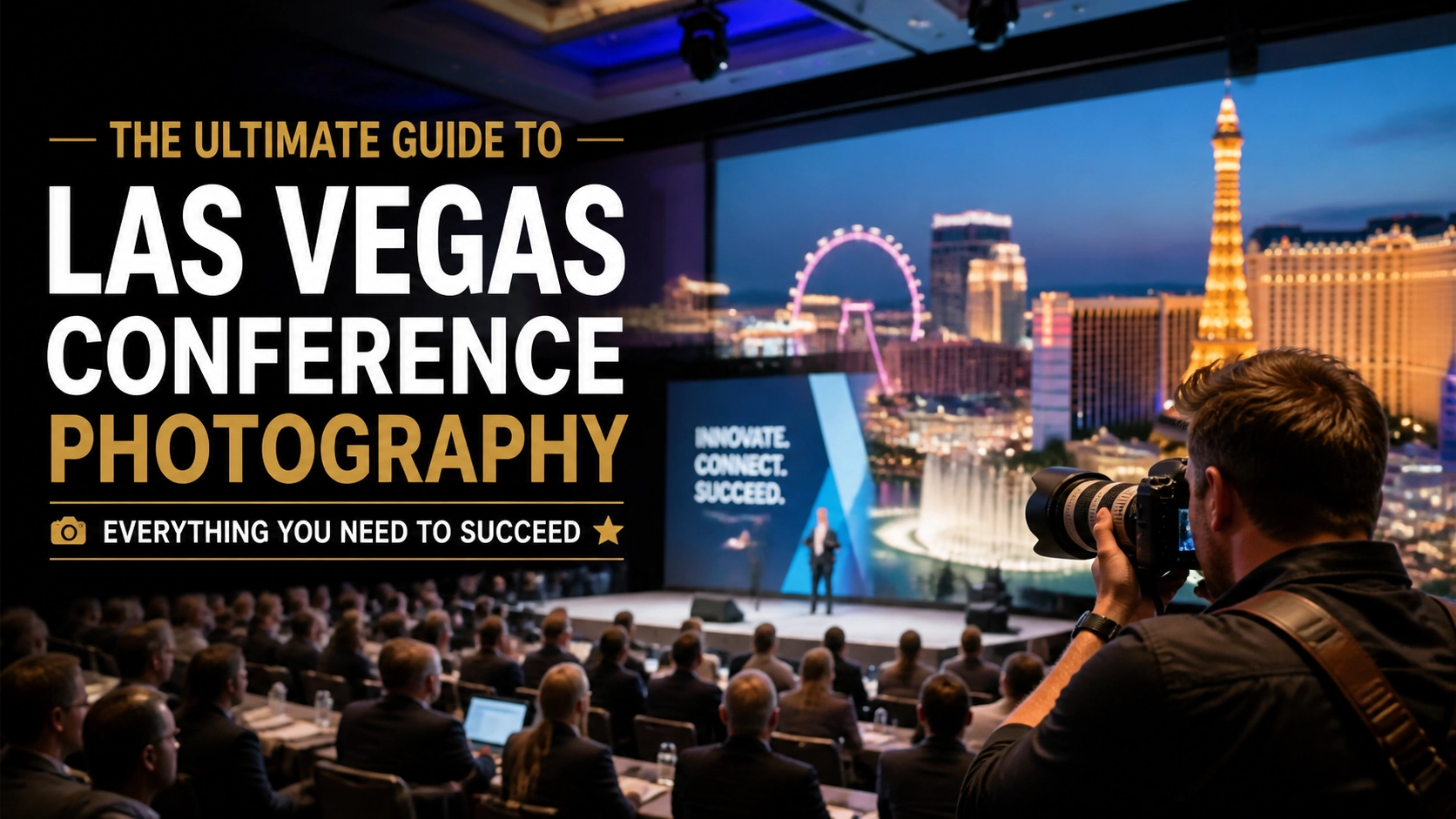
Alt Text: A professional photographer capturing a wide-angle shot of a massive keynote stage at a Las Vegas conference with dramatic blue lighting and a large audience.
Mastering the Lighting of the "Neon Desert"
Las Vegas venues are notorious for their lighting: or lack thereof. You often deal with "cave-like" ballrooms with 30-foot ceilings that swallow light, or trade show floors filled with a nauseating mix of yellow tungsten, blue LEDs, and green fluorescent overheads.
A professional event photographer doesn't rely on the "Auto" mode. To succeed here, you must master:
- High-ISO Performance: You’ll often be shooting at ISO 3200 or higher. This requires full-frame sensors that can handle noise without losing detail.
- Off-Camera Flash: Direct on-camera flash creates harsh shadows and a "deer in the headlights" look. Using triggered flashes or bouncing light off white ceilings (if they aren't too high) adds depth and professional polish.
- Color Temperature Correction: Mixed lighting is the enemy. Expert corporate photography services involve shooting in RAW format to ensure that skin tones look natural, regardless of whether the stage is bathed in corporate purple or neon green.
If you’re looking for inspiration on how to handle these complex environments, our video gallery showcases how we balance light and motion in some of the most challenging venues in the country.
The Art of the Keynote: Capturing the Powerhouse Moments
The keynote is the heart of any conference. It’s where the big announcements happen and where the energy is highest. However, shooting a speaker on stage is harder than it looks. You have to contend with giant LED backdrops that can cause "banding" in your images or blow out the exposure.
To get the perfect shot:
- Vary the Perspective: Don't just stand in the center aisle. Get low at the front of the stage for a "larger than life" hero shot. Then, move to the back of the room with a long telephoto lens (70-200mm or 400mm) to capture the speaker framed by the audience's silhouettes.
- Watch the Face: Timing is everything. Wait for the speaker to stop moving or make a hand gesture that emphasizes a point. Avoid shots where their mouth is awkwardly open or their eyes are closed.
- Capture the Reaction: Some of the best keynote photos aren't of the speaker at all: they’re of the audience laughing, clapping, or leaning in with intensity.
For larger productions, combining these stills with conference videography creates a multi-sensory recap that can be used for years to come. Many clients now opt for integrated event videography services to ensure their keynote content is repurposed for YouTube and LinkedIn.
Candid Storytelling and the Human Element
While the stage shots are important, the real "magic" happens in the hallways, the breakout sessions, and the networking mixers. This is where business event photography becomes about human connection.
The best corporate event videographer or photographer is a "ninja." You want to capture authentic interactions without being intrusive. When people see a giant lens pointed at them, they freeze up. The trick is to blend in. Use a longer lens to capture conversations from a distance, or wait for a group to finish a laugh before asking for a quick posed "grip and grin."
These candid moments are what sell the event for the following year. They show that your conference isn't just a series of lectures, but a community. If you need to see how these stories come together, check out our blog for case studies on past events in cities like Orlando, Chicago, and New York.

Alt Text: Two business professionals in professional attire laughing and networking during a coffee break at a corporate event, captured in a candid, bright style.
Beyond Stills: The Rise of Conference Videography
In 2026, photography alone isn't enough. Modern brands require event video production to keep up with the demands of social media. A highlight reel (usually 60 to 90 seconds) is the industry standard for post-event marketing.
When we talk about conference videography, we aren't just talking about a camera on a tripod at the back of the room. We’re talking about gimbal-stabilized "fly-through" shots of the expo floor, drone footage of the Las Vegas Strip, and "man-on-the-street" style interviews with attendees.
The synergy between your event photographer and your video team is crucial. They shouldn't be fighting for the same spot. A coordinated team, like the ones managed through www.proshoot.io, ensures that the shutter clicks don't ruin the audio of a sensitive interview and that the videographer isn't in the back of every photo.
Technical Essentials: The Gear That Makes the Difference
You wouldn't bring a knife to a gunfight, and you shouldn't bring consumer-grade gear to a Las Vegas trade show. If you are hiring corporate photography services, ask your provider about their kit.
- Dual Slots: A professional camera must have two memory card slots. If one card fails (and they do), the second card is the insurance policy for the client's investment.
- Fast Glass: Lenses with a wide aperture (f/2.8 or wider) are essential for blurring out distracting backgrounds and letting in enough light in dark ballrooms.
- Redundancy: Every conference photographer should have at least two camera bodies on them at all times. If a shutter jams during the CEO's opening remarks, there are no "do-overs."
Navigating the Logistics of Major US Hubs
While this guide focuses on Las Vegas, the principles apply to all major event hubs. Whether you need a corporate event videographer in Atlanta, a photographer for a tech summit in San Francisco, or coverage for a financial conference in NYC, the logistical hurdles remain similar.
- Venue Scouting: Always arrive a day early to walk the floor. Check the distance between the main stage and the breakout rooms. In Vegas, this walk can take 15 minutes!
- Local Regulations: Some cities and venues have strict union rules regarding who can operate equipment. Always ensure your event videography services are compliant with local labor laws.
- Data Security: In a world of corporate espionage, the security of your event’s data is paramount. Ensure your photography team uses encrypted drives and secure galleries. You can view our privacy policy to see how we handle sensitive client data.

Alt Text: A high-tech camera setup on a gimbal used for event video production, positioned in front of a blurred trade show background.
Why Professional Execution Matters
At the end of the day, high-quality imagery is an investment in your brand's future. Cheap photography looks… cheap. It tells your audience that your event wasn't a "must-attend" occasion. Conversely, polished, vibrant, and professionally composed images elevate the perceived value of your conference.
When you hire Corporate Pixels, you aren't just hiring someone to "take pictures." You are hiring a team that understands the rhythm of a corporate schedule, the importance of VIP etiquette, and the technical demands of high-production environments.
If you’re planning your next big move in the event space, don't leave your visual legacy to chance. Reach out to us via our contact page to discuss how we can bring your next Las Vegas event to life. Whether you need a solo event photographer or a full-scale event video production crew, we have the local expertise and the national reach to ensure you succeed.
For more examples of our work in different formats, feel free to browse our horizontal gallery or see how we handle two-column layouts for complex brand storytelling.
Success in Las Vegas is about more than just showing up: it’s about standing out. Let’s make sure your event is the one everyone remembers.