Selecting the right conference photographer is a strategic decision that directly impacts your brand’s post-event marketing and long-term visual legacy. High-stakes corporate events demand more than just a person with a camera; they require a specialist who understands the rhythm of a keynote, the nuances of networking, and the technical constraints of diverse venues. Whether you are hosting a tech summit in San Francisco or a global trade show in Las Vegas, the quality of your corporate event photography determines how your audience perceives the event's success.
The Standard for Modern Corporate Event Photography
A professional event photographer does not simply document an event; they curate a narrative. This involves a blend of technical mastery and corporate intuition. When evaluating talent, prioritize professionals who demonstrate a deep understanding of light management in cavernous convention centers and the ability to capture candid, high-value interactions without disrupting the flow of the session.
To ensure you are hiring top-tier talent, focus on these core competencies:
- Discreet Presence: The ability to navigate a room without drawing attention away from the speakers or attendees.
- Rapid Turnaround: Top-tier services now offer "real-time" or same-day edits for social media amplification.
- Technical Versatility: Mastery over low-light environments, high-contrast stage lighting, and macro-photography for branding details.
For organizations managing multiple events across different regions, utilizing a platform like Proshoot can streamline the vetting process, ensuring that the corporate photography services you book meet a consistent global standard.
Regional Comparisons: Navigating Major US Markets
The requirements for a conference photographer vary significantly depending on the city and the specific venue. Each major US hub presents unique challenges and expectations.
New York City: The High-Pressure Corporate Standard
In New York City, the pace is relentless and the venues: ranging from historic hotels like the Waldorf Astoria to modern hubs like the Javits Center: require a photographer who can work in tight, high-security environments. Corporate event photography in NYC often focuses on high-profile speakers and VIP networking.
- Key Requirement: Speed and professionalism. Photographers must be comfortable around C-suite executives and high-net-worth individuals.
- Logistics: Knowledge of Manhattan’s logistical hurdles is essential for on-time arrival.
Las Vegas: Mastering the Convention Giant
Las Vegas is the world capital of large-scale trade shows. A conference photographer in this market must be an expert in scale. Capturing the sheer magnitude of the Las Vegas Convention Center or Mandalay Bay requires specialized wide-angle equipment and the stamina to cover miles of floor space.
- Key Requirement: Experience with massive booth designs and large-group dynamics.
- Video Integration: Given the scale, many clients opt for comprehensive event video production alongside photography to capture the kinetic energy of the show floor.

Alt text: A professional photographer capturing a high-energy keynote speech at a major tech conference in a large Las Vegas convention hall, showcasing the scale of the venue and the professional lighting setup.
Chicago: Architectural Backdrops and Industrial Scale
Chicago events often blend the industrial scale of McCormick Place with the sophisticated aesthetics of the Loop. Business event photography here frequently incorporates the city’s iconic architecture as a backdrop for corporate retreats and outdoor networking sessions.
- Key Requirement: Versatility between indoor convention settings and outdoor urban environments.
- Standard: High-end corporate photography services in Chicago are expected to provide detailed coverage of both the "work" and the "atmosphere."
Orlando and San Francisco: The Tech and Association Hubs
Orlando dominates the association and medical conference market, while San Francisco remains the epicenter of tech. In Orlando, the focus is often on high-volume attendee engagement and branding. In San Francisco, the aesthetic is more candid, tech-forward, and geared toward immediate social media impact.
- San Francisco Requirement: Tech-savvy shooters who can provide instant digital delivery for live-tweeting or LinkedIn updates.
- Orlando Requirement: Reliability in capturing large-scale awards ceremonies and multi-day workshops.
Integrating Event Videography Services
A modern conference is rarely captured by stills alone. The synergy between a corporate event videographer and a photographer is vital for a cohesive brand narrative. Event videography services provide the motion and sound that photography cannot: capturing the passion of a keynote or the testimonial of a satisfied attendee.
When hiring for conference videography, look for teams that offer:
- Sizzle Reels: 60-90 second high-energy clips for post-event marketing.
- Full Session Recording: Multicam setups for archival or digital-on-demand purposes.
- Interview Clips: Professionally lit and mic’d "man-on-the-street" style interviews with attendees.
Comprehensive event video production ensures that your event lives on long after the final session concludes. By coordinating your photography and videography teams, you ensure consistent color grading and a unified visual style across all platforms. Check out our video gallery to see how these elements work in tandem.

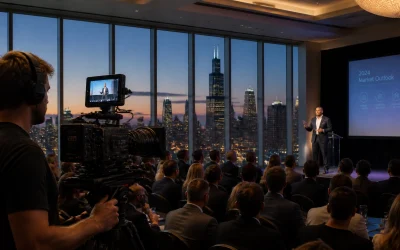
Alt text: A corporate event videographer using a gimbal-stabilized camera to record a dynamic panel discussion, highlighting the professional equipment and focus on high-quality event video production.
The Evaluation Process: How to Vet a Conference Photographer
To find the best talent, you must look beyond the "best of" lists. Follow this prescriptive workflow to evaluate potential partners:
1. Portfolio Relevance
Review portfolios specifically for conference work. A wedding photographer or a portrait specialist may have a beautiful aesthetic, but they may lack the experience to navigate a darkened keynote hall or a crowded trade show floor. Look for:
- Consistent exposure in difficult lighting.
- A mix of wide, medium, and tight shots.
- Sharp, well-composed images of speakers in mid-sentence (avoiding awkward mouth positions).
2. Technical Capabilities and Equipment
Ask about their gear. A professional conference photographer should carry redundant equipment (two camera bodies at all times) and lenses that cover everything from ultra-wide (for venue shots) to long telephoto (for stage close-ups from the back of the room).
3. Insurance and Contracts
Never hire a corporate event videographer or photographer without proof of liability insurance. Most major venues, like those found in the project categories we cover, require a minimum of $1,000,000 to $2,000,000 in coverage to step on-site.
4. Turnaround and Delivery
Define your expectations for delivery before signing.
- Next-Day Highlights: A selection of 20-50 images for immediate press releases.
- Full Gallery: Typically delivered within 5-10 business days via a professional hosting platform.
- Usage Rights: Ensure your contract includes full commercial usage rights so you can use the images for future marketing, website updates, and social media without recurring fees.
Leveraging Professional Networks
Navigating the landscape of corporate photography services can be overwhelming when you are also managing event logistics. This is where centralized platforms and established agencies provide the most value.
At Corporate Pixels, we specialize in matching the right talent to the specific needs of your city and venue. If you are looking for a verified professional with a proven track record, visiting Proshoot.io allows you to browse specialized talent that has been vetted for the exact rigors of the corporate world.

Alt text: A split-screen comparison showing the difference between standard event photography and high-end corporate event photography, focusing on lighting, composition, and brand placement.
Strategic Planning: The Pre-Event Brief
The difference between good and great business event photography often lies in the brief. Once you have selected your event photographer, provide them with a detailed roadmap of the event:
- The Shot List: Identify key VIPs, specific branding elements, and "must-have" moments (e.g., a ribbon-cutting or a specific keynote interaction).
- The Schedule: Highlight the most important sessions. If there are concurrent tracks, specify which one takes priority.
- The Branding Guidelines: If your brand has a specific "look" (e.g., high contrast, airy, or specific color palettes), communicate this early to ensure the editing style matches your existing assets.
For more information on how to structure your event for the best visual results, you can explore our blog for more industry insights.
Comparison Table: Photographer Requirements by City
| City | Primary Focus | Technical Challenge | Recommended Service |
|---|---|---|---|
| New York City | VIPs & Executive Presence | Tight spaces, high security | Corporate Event Photography |
| Las Vegas | Scale & Trade Show Floor | Massive lighting variations | Event Video Production |
| Chicago | Architecture & Industry | Indoor/Outdoor transitions | Conference Photography |
| San Francisco | Innovation & Candid's | Rapid social media turnaround | Business Event Photography |
| Orlando | Branding & Engagement | High-volume attendee shots | Corporate Photography Services |
Finalizing Your Decision
Choosing a conference photographer is an investment in your brand’s future marketing efforts. By focusing on city-specific experience, technical proficiency, and the ability to integrate event videography services, you ensure that your event is captured with the professional polish it deserves.
When you're ready to book or if you need a consultation on your next project, feel free to contact us directly. Whether you need a corporate event videographer in Los Angeles or a photography team in Boston, prioritizing quality and expertise will always yield the best ROI. For a broader range of options and to see a network of specialists, Proshoot remains the premier destination for finding the talent that fits your specific corporate needs.
Remember, the images captured today will be the primary tool used to sell your event for next year. Don't leave your visual legacy to chance; choose a partner who understands the business of photography as well as the art of it.